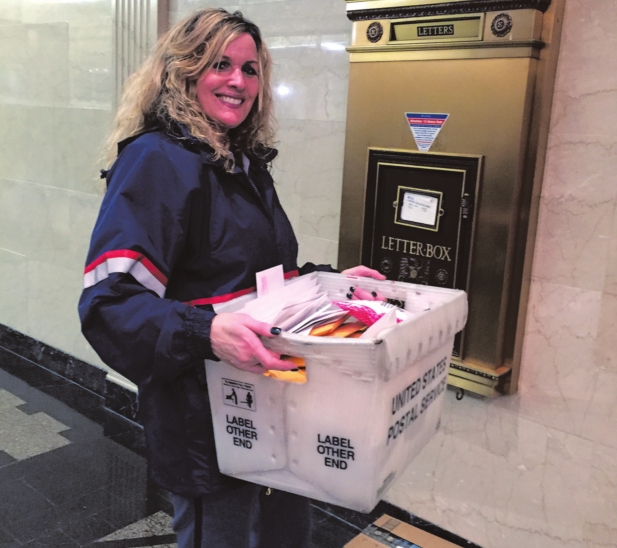
The United States Postal Service is confident that your holiday mail will be on time, so long as you get your shopping and shipping done early.
The
first deadline, for USPS ground advantage and first-class mail, is
December 18. Priority mail and priority mail express should be sent by
December 19 and 21, respectively. For Hawaii, Alaska and military or
international destinations, consider shipping at least a few days to
more than a week earlier. More information on recommended deadline dates
can be found on the USPS website.
A
string of successes in recent years, since the implementation of the
Delivering For America plan, has given the USPS confidence that the
postal service has made the necessary adjustments to accommodate rapid
changes in how people use mail carriers.
“The
way people use the mail today is obviously different than it was 30-40
years ago,” said Stephen Doherty, a USPS communications representative
for the Northeast. “There's been a decline in the letter size mail,
whereas packages have kind of gone through the roof. So, we've had to
adapt to that, retooling our facilities and our transportation networks
and adjusting things to suit the new reality. We're in a good position
this year and confident that we'll get through the holidays without a
glitch.” In 2023, the percentage of on time delivery during the peak
holiday season hovered around or above 90%. First class mail saw an
on-time delivery percentage increase by 28.5% from 2021, when the USPS
received a record volume of 13.2 billion shipments in the midst of the
COVID-19 pandemic, to 2023.
“When
the pandemic hit, people stopped traveling. A lot of our stuff at the
time was flying on commercial airlines, so we’re competing for the
[limited] cargo space with other companies,” Doherty said. “So, part of
what they're doing with this Delivering For America plan is relying more
on ground transportation. It's more reliable. We can get stuff across
the country without weather interfering with it as much, and it's more
cost effective.”
In
New England, the biggest challenge affecting on time deliveries is
unexpected weather, according to Doherty. Other challenges, like the
need for a rapid influx of seasonal hires, have been mitigated in recent
years. A typically low unemployment rate in New England has
historically made it difficult to reach seasonal hire numbers, but those
quotas have been reduced by higher employee retention and converting
seasonal hires to year-round positions.
This year is also the first year that the USPS will be delivering using electronic vehicles around the country.
“In
addition to saving on fuel costs, the Postal Service’s use of
[electric] vehicles is ideally suited for this,” Doherty said. “Leave
the office in the morning, go out, deliver their routes and come back,
it's usually over a shorter span of space. So being able to charge them
every night and have them ready to go the next day, they kind of work
well for us.”
The
battery-powered fleet isn’t new to New England, but the expansion is
part of efforts to put the postal service in the black. Though it
doesn’t receive tax dollars, the USPS is still dedicated to operating as
a service, the only mail carrier that reaches every address in America.
To
make doubly sure it gets there, Doherty recommended putting the
delivery address and return address on a slip of paper inside the
package in case it gets separated from the shipping label.
“If
you’re sending a package, Julie Andrews might be a big fan of brown
paper packages tied up with string, but we really prefer a good solid
box with packing tape on it,” Doherty said. “And if there’s any snow
coming up on the holidays, don’t forget your letter carrier and clear a
path to your home or mailbox so we can make the delivery safe.”