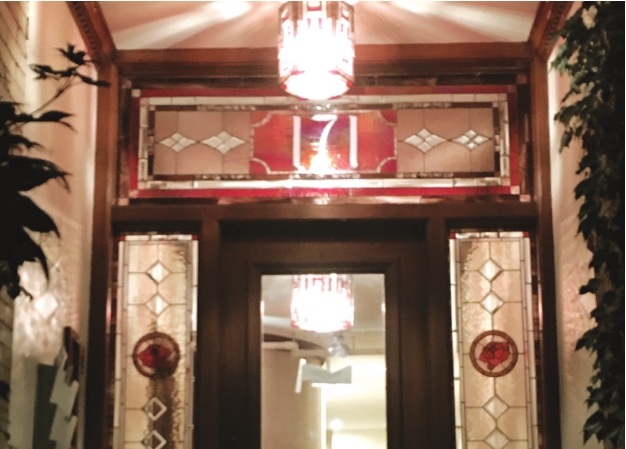
A little-known history of St. Botolph has emerged thanks to the work of resident historian Dan d’Heilly.
A story of stained-glass artistry, legacy defining craftsmen and real estate strategy made the compact eight-block enclave the site of the triumph of the handmade in an age of industrialization.
In the late 19th and early 20th centuries, the St. Botolph area was known as Stained Glass Row. Today, an estimated 200 stained glass windows are still on display, a visual timeline that d’Heilly said spans three distinct eras.
Once
a marshy swampland, the Back Bay was initially filled in with plans to
construct an industrial district. When factory construction fell short
of expectations, the developers pivoted to the luxury real estate
market. Unique stained glass windows were once such marker of luxury,
due to the resurging interest in handcrafted goods as mass production
was taking over.
“They
were rejecting the mass produced shite that people were putting out,”
d’Heilly said in an interview. “As soon as you had factories that could
stamp a piece of metal, you had stamped metal on everything. So, what
they were saying is, ‘We don’t want cheap stained glass. We want quality
stained glass. We want to see the craftsmen’s fingerprints on the
pieces.’”
An 1897
arts and crafts show at the Museum of Fine Arts, then located at Copley
Square, helped the area receive recognition nationwide as an early hub
of the handmade arts and crafts movement.
In
this first era, the row houses carry the signature of their builders,
repeating motifs in the stained glass beside front doors, and groups of
four to seven townhouses sharing design details.
One of d’Heilly’s favorite examples is the row of townhouses from 124 to 132 St. Botolph Street.
The
second era begins in 1913, d’Heilly said, with the opening of Charles
Jay Connick’s stained glass studio at 9 Harcourt Street, and a second,
John Terrence O’Duggan's studio at 116 St. Botolph Street in 1933.
“St.
Botolph had two streets, not just one, that were dedicated to arts and
crafts, Irvington and Harcourt,” d’Heilly said. “Irvington is now
underneath Copley Place Mall. That’s one of the reasons why the arts and
crafts movement is finished here. The whole area was something just
short of being an artist’s colony.”
Connick
learned the craft of stained glass while working in a Pittsburgh studio
that practiced the more widely known Tiffany style. The Tiffany is
marked by the usage of a more opaque layering of glass. But a trip to
Europe to study Gothic architecture inspired Connick to bring light back
to the stainedglass craft.
“The
big difference was the Gothic revival school held that you needed to be
able to see through the glass clearly. As much sunlight as you can get
through the better. Whereas the Tiffany style was all about creating an
entire [picture] out of glass,” d‘Heilly said. “Tiffany went out of
business in 1933. Connick went on for another 50 years. So, the Connick
style essentially won.”
From
1913 to 1986, Connick’s studio produced over 15,000 stained glass
windows in his distinct style that were spread worldwide. The studio
remained an artist’s cooperative even after his death in 1945. It closed
in 1986 because the modern high-rises of Copley Square were obstructing
the natural light source essential to the craftsmen’s work.
“That
brings us to the third era,” d’Heilly said. “In the 1990s, the area
began to pick up the pace of being gentrified. So today, we have a dozen
new stained-glass windows that people have put up over the last 30
years. I would love to see us go from a dozen to two dozen, or three
dozen. Wouldn’t it be great to have this inspire people in this
neighborhood to really have an unusual oasis of ancient and new stained
glass?”


