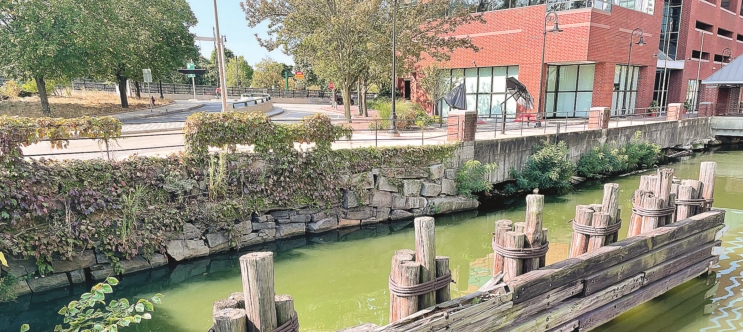
The Massachusetts Water Resources Authority (MWRA) plans to dump raw sewage in the Charles River forever.
Under a new proposal issued by the MWRA at the end of October, the agency would undertake infrastructure upgrades to cut sewage discharge into the river in half by 2050. But the water quality of the Charles would change from temporarily allowing limited sewage overflows to permanently allowing them.
“This would be a significant downgrade, and it would remove the legal leverage that we currently have to require more cleanup,” Emily Norton, the executive director of the Charles River Watershed Association, a nonprofit dedicated to preserving the health of the river for the past 60 years, said in a webinar last Friday. “This is really really terrible.”
Boston
has a combined sewer system, in which raw sewage pipes overlap with
stormwater drainage pipes that connect to the storm drains at street
level. Normally, this causes little issue. But if there is a rainstorm,
the pipes are flooded with stormwater, and to prevent an overload,
excess water is dumped from the system into the river. Because the storm
drain pipes connect to the sewage system, that water is contaminated
with untreated sewage. This is called a Combined Sewer Overflow (CSO).
Under
the Charles’s current water quality classification of Class B, which
puts it in the “swimmable” range, no such overflows are technically
allowed. But, because the MWRA has been taking steps to update the
sewage system, state regulators have granted it a limited volume of 13
million gallons of permitted sewage discharge per year, for a limited
time while those infrastructure improvements are made.
Under the new proposal, that limited volume would be expanded to 30 million gallons and be in place permanently.
“What
the MWRA just proposed last week in their memo is that they want to
reclassify the Charles as a different classification, called Class B
(CSO),” Norton said in the webinar, which is available in full on the
CRWA’s YouTube channel. “If you have that, you are allowed to have CSOs
in limited times, which means every big storm, forever. That’s the point
of all of this.”
The
MWRA says it’s not that easy. Since it began upgrading combined systems
in 1998, the Authority has removed nearly 90 percent of CSOs in the
state of Massachusetts, according to an October report by the Harvard Crimson; Frederick Laskey, the MWRA’s executive director, said at the time that the agency had already spent $900 million on the project.
In
response to this proposal, however, the CRWA has collected over 3,700
emails and 1,500 petition signatures as part of its “Cut the Crap”
campaign to demand that the MWRA not move forward.
“If
it’s the CRWA against the MWRA, we will lose,” Norton said. “If it’s
the CRWA and Greater Boston residents against the MWRA, we will win. It
is as simple as that.”
The MWRA Board is expected to vote on the proposal at its upcoming public meeting on November 19.


