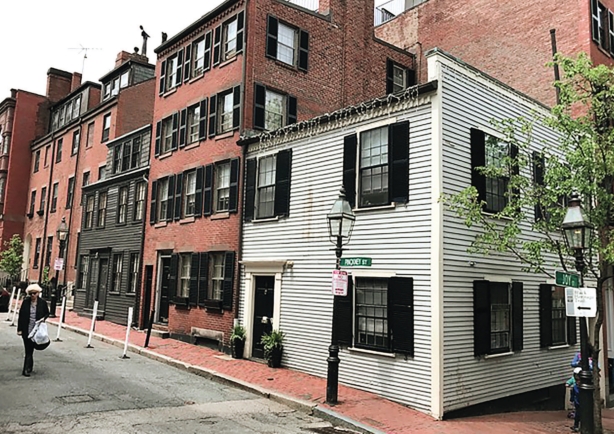
1, 3 and 5 Pinckney StreetThe term “Beacon Hill” is almost synonymous with “Boston Brahmin,” but a close inspection of the neighborhood’s five oldest homes reveals a far more diverse and financially fraught heritage.
In the History Project’s Improper Bostonians: Lesbian and Gay History from the Puritans to Playland, the builders of Beacon Hill’s oldest home, George Middleton and Louis Glapion, are portrayed as sharing a “romantic same-sex friendship.”
The
alleged lovers, both African-American, built the wooden house at 5
Pinckney Street in 1787, though a 2001 report filed with the
Massachusetts Historical Commission does not rule out the possibility
that the two “pooled their assets for purely pragmatic reasons as a
means to become property owners.”
Prince Hall, founder of the country’s first African-American masonic order, sent them to develop the property.
“Beacon
Hill wasn’t always as desirable as it is now,” said L’Merchie Frazier,
the Museum of African American History’s director of education and
interpretation. “The black community needed to get away from the blight
of the wharves and the North End, and so they decided to build a
community on Beacon Hill.”
The
neighborhood’s second oldest home, also wooden, was likely built as the
“shop ell” of Middleton and Glapion’s property. Glapion later married a
woman and ran a barber shop out of this half of the two-family
residence. In 1833, a 4-story brick structure was built and separated
Middleton and Glapion’s property into discrete addresses, the latter now
identified as 1 Pinckney Street.
Beacon
Hill’s third oldest home, at 141 Cambridge Street, reveals 18th century
real estate speculation at the higher end of the market. Designed by
the renowned architect Charles Bulfinch, developer Harrison Gray Otis
occupied the brick mansion from 1796 to 1800 before moving into a
similar, slightly larger home at 85 Mount Vernon Street, also designed
by Bulfinch.
“He was
basically developing the hill and building houses for himself that were
kind of show homes,” said Catherine Truman, an architect who renovated
Otis’ second home in the early 2000s.
For
all their collaborations, Bulfinch and Otis were never close. As Otis’s
development, largely designed and laid out by Bulfinch, raked in
tremendous profit, Bulfinch’s finances were insolvent by 1811. To
absolve his debts, Bulfinch spent a month in a prison he had designed
himself years earlier.
The
fourth oldest home on Beacon Hill is 43 South Russell Street, built by a
paper stainer in 1797 or 1798. The simple painted-brick structure was
likely used as a bakery during the 1820s, on account of a tremendous
fireplace and oven in its basement, which was accessible from the
street.
Both built in
1799, two wooden houses on Smith Court rented predominantly to
African-Americans during the early 19th century tie for Beacon Hill’s
fifth oldest home. From 1851 to 1856, the journalist William C. Nell
rented a unit at 3 Smith Court. Nell became the country’s first
published African-American historian when he released, in 1851, Services of Colored Americans in the Wars of 1776 and 1812.