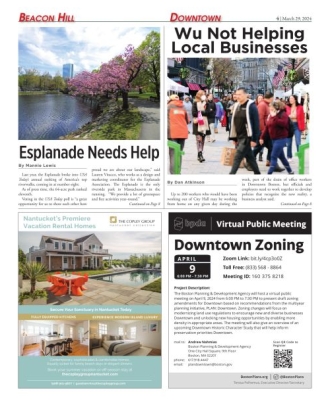
Up to 200 workers who would have been working out of City Hall may be working from home on any given day during the week, part of the drain of office workers in Downtown Boston, but officials and employers need to work together to develop policies that recognize the new reality, a business analyst said.
That
could mean keeping hybrid schedules while trying to increase
residential development, promoting downtown events and pushing back on a
real estate transfer tax, said Doug Howgate, president of the
Massachusetts Taxpayers Foundation.
Howgate said City Hall workers were part of a larger trend in hybrid work that needed to be acknowledged.
"It's
never about one specific employer or class of worker. It's about
recognizing change or the adjusted reality where every worker being in
the office five days a week in the Central Business District is probably
not the way the world will look like for the foreseeable future,"
Howgate said.
"Some
things that we typically relied upon, that office workers would be in
five days a week and go get lunch. That's not going to be as strong as
it has been. I don't care what any individual employer does. The gravity
of that has weakened.
"For
any region to be successful economically, you need people to be active
there. It could be working, living or tourists," Howgate added. "If the
reality is fewer workers are going to be downtown compared to how things
used to be, how are we not making the problem worse and how do we
replace that activity? Those are really challenging policy problems."
City
Hall has between 1,200 and 1,400 employees working out of the building,
city officials said. The number varies every day due to workers taking
time off but also working on hybrid schedules.
The
city's Hybrid Work Policy, which was approved a year ago, allows
approved workers to work outside of City Hall up to two days a week.
The
policy is "a means of supporting the evolving needs of [City Hall's]
workforce while advancing its effectiveness in serving the public.
Although hybrid work schedules are not appropriate for many city
positions, this policy recognizes and embraces the dynamic, continually
evolving nature of work today and into the future," the policy reads.
City
Hall employees working remotely have the same hours as their regular
schedule and must "perform all of the essential functions of their
position." Department heads have to approve any hybrid work plan. And
people working a hybrid schedule will still have to work if employees at
City Hall are dismissed for something like a snow emergency, according
to the policy.
Even
working from home one day a week can affect businesses like eateries
that catered to Downtown office workers, Howgate said. That's borne out
by the changing hours of the Recreo coffee shop based out of City Hall.
Pre-pandemic it was open from 7:30am to 4pm Monday to Thursday and
7:30am to1 pm on Friday. Now it's open 7:30am to 3pm Monday to Thursday
and only once a month on Friday, from 7:30am to 1pm.
"Office
workers are still going to be a huge part of what we do downtown, but
even if you're in the office four days instead of five, that's a 20
percent decline in your time downtown. If you aggregate that, there's
going to be a big impact," Howgate said, while noting that people
working from home in residential neighborhoods around Downtown could
still be enticed to the area. "We need to proactively price that into
policy discussions and diversify the portfolio of economic activity,
make sure people in Beacon Hill who are working from home are also going
out for lunch."
And
Howgate said tourism in Downtown remains strong, and that he supported
events and other activities that could draw people to the area to
replace workers who are now at their homes. But he also saw increased
residential development as a way to permanently bring people to the area
and warned that a proposed real estate transfer tax could hamper that
development.
"We need
to be humble and know we're not going to know exactly what the future
looks like, but we need to build into policy decisions that it's not
going to look like what it did," Howgate said. "The transfer tax,
whatever you thought five years ago, the situation looks different now.
We don't want to get baked into things that folks were looking at when
the situation looked a lot different."