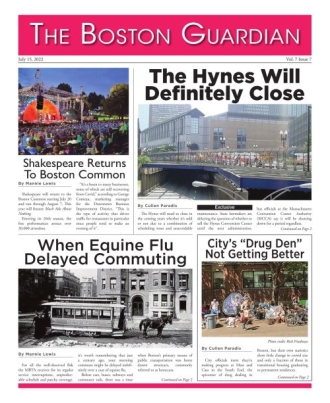
For all the well-deserved flak the MBTA receives for its regular service interruptions, unpredictable schedule and patchy coverage, it’s worth remembering that just a century ago, your morning commute might be delayed indefinitely over a case of equine flu.
Before cars, buses, subways and commuter rails, there was a time when Boston’s primary means of public transportation was horse drawn streetcars, commonly referred to as horsecars.
These
open-air trolleys were attached to railroad tracks along the roads of
Downtown Boston and Cambridge, not unlike the street-level portion of
the Green Line’s western branches, but without engines or motors.
Instead, their forward movement relied on horsepower.
The
Massachusetts Historical Society dates Boston’s first operational
horsecar back to 1856, traveling between Cambridge’s Central Square and
Bowdoin Square in Boston’s West End. Over the next decade, the
popularity of these equine trolleys grew until there were routes across
the city.
The trolley cars varied in size, with some of the larger ones requiring teams of horses, while others used just one.
This
was long before the days of the MBTA, when Boston had yet to establish
any sort of government-run transportation system. The horsecars fell
under the jurisdiction of twenty separate railroad companies, each vying
for greater ridership.
Between
the score of competitors, eight thousand horses were employed pulling
trolleys throughout Boston during the nineteenth century, according to
data from the Allston Brighton Historical Society. Eventually, these
twenty companies were consolidated into the West End Street Railway.
At
the time, the chief concern amongst residents regarding horsecars was
the placement of tracks directly on the streets, which many felt would
decrease the quality of the road, in addition to creating safety issues.
But since horse drawn streetcars were faster and offered a smoother
ride than any nineteenth century alternative, these skeptics were soon
won over.
However, the
horsecars weren’t without their problems. Feeding eight thousand horses
was extremely expensive, resulting in high fair prices set at the mercy
of private companies. Attempts to minimize horse-related expenses led
to these companies overworking their horses, who often became ill and
died. Whenever contagious equine diseases swept through the city, the
entire transportation system would be forced to shut down.
In
the end, the reign of horsecars was short-lived, lasting only three
decades until the invention of the electric-powered streetcar, a faster,
cleaner, more reliable option. The West End Street Railway gradually
phased out its horsecars, replacing them with their electric
counterparts and electrifying the tracks where the horses once traveled.
For
a brief time, the company attempted to run both electric and horse
drawn streetcars on the same tracks, until a team of horses was
electrocuted, causing this idea to be abandoned.
Boston’s
last horsecar line was a track along Marlborough Street in the Back
Bay, which finally closed in 1900, a few years after the construction of
the city’s first subway.