The latest book from Boston historian Anthony Sammarco chronicles the city’s burlesque tradition, detailing how the exotic dancing industry vitalized neighborhoods and often led the charge on social progress.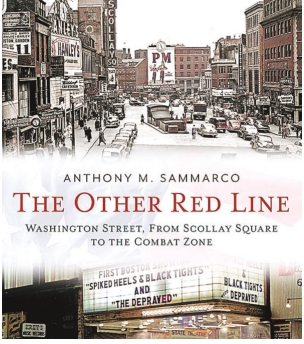
Sammarco gave audiences a taste of his latest book, entitled The Other Red Line, during a December 8 event.
While the presentation did have its fill of suggestive details, Sammarco also found time to recount the effect Boston's nascent burlesque industry had on the local economy.
“The whole concept of Scollay Square was that the whole area was thriving,” he said.
“Many people would come not just to the various business venues but to the Old Howard theater. Business provided both entertainment and food. In this photo you can see a sign saying that bars would provide good food and even booths for women customers. These businesses attracted people from all walks of life.”
The vaudeville performances of the 40s evolved into raunchier burlesque shows, building up an entire business ecosystem around their attraction and eventually moving to the raucous neighborhood known colloquially as the Combat Zone.
Scollay Square’s urban renewal in the late 1950s had Boston’s adult entertainment looking for a new home, and the Combat Zone’s thriving nightlife was the perfect environment.
“Even before Scollay Square’s luster began to tarnish, before it was swept away by the urban renewal of the 1960s, Washington Street south of Avery Street began to increasingly change and eventually become known as the Combat Zone,” said Sammarco.
“Orchestras and movies with audio really began to attract attention to the neighborhood.”
In
addition to the industry’s regional impact, it acted as a stepping
stone for many of its working women. Despite the job’s seedy reputation,
the use of exotic dancing as a ticket to higher education was noted at
several points throughout Sammarco’s recounting.
“I can’t imagine the number of collegiate young women who were dancing at the cabarets,” he added.
“A
woman who went by ‘Princess Cheyenne’ was a headliner at the Naked Eye.
Few realized that she had graduated from Emma Willard, an exclusive
all-girls boarding school in New York. The Harvard Lampoon once hired
her and referred to her as ‘a nice and educated girl.’ She stripped to
work her way through college.”
Women weren’t the only ones getting a leg up through the neighborhood’s nightlife.
The
Combat Zone saw even more integration of different classes and
demographics than its precursor and boasts several of the first
integrated establishments in the area.
“The
Combat Zone began to change subtly as these businesses moved in. It
accepted people from all walks of life,” commented Sammarco..
“Two
gentlemen pictured here are at the Silver Dollar Bar, one of the few in
the area that did not have that did not discriminate by race or sexual
orientation. It was a popular hangout for sailors and servicemen, but
unlike Scollay Square it also attracted plenty of women that wanted to
be entertained.”