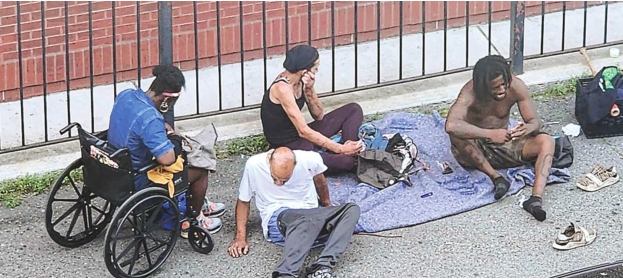
The Mass and Cass working group has begun drafting plans to actually implement its new homelessness and addiction recovery framework, but with warm weather closing in it remains to be seen whether any of it can materialize before this year’s surge.
The action plan itself is the culmination of months of effort from a broad coalition of community activists, elected representatives and appointed officials. Published last month, it aims to both completely stop street drug use and accomplish that without sending nonviolent offenders into the criminal system.
The first half of that equation would be accomplished through effectively a zero tolerance policy, expanding the Boston Police Department’s (BPD) ‘s specialized N.E.S.T. teams and engagement by the city’s coordinated response team social workers.
Members of the working group objected to initial media interpretations of this as a crackdown, noting that while they do hope to increase enforcement, nonviolent offenders would be routed away from the conventional criminal justice system toward pre-arraignment specialty drug courts.
Surging
enforcement personnel is perhaps the most easily accomplished policy
change, with the mayor’s office in charge of both the BPD and
coordinated response team. The mayor’s office declined to share any
immediate details on implementation beyond thanking the working group
and saying that “the city is focused on active preparations for warmer
weather and continuing to engage with all stakeholders on our
coordinated approach,” but District 3 City Councilor John Fitzgerald
told The Boston Guardian those changes could begin essentially at will.
If
those additional boots on the ground require additional funding,
however, that would fall to the city council’s budgetary process.
Fitzgerald was optimistic about its level of support but noted this
year’s budget might not get a final vote until June.
“We’re
trying to fit within an existing framework,” he said. “We’re not trying
to go to providers and say, ‘run differently.’ We’re not trying to go
to the courts and say, ‘do it differently.’ We’re trying to go to the
process that exists and plug in the gaps.”
If it does go to a vote, it will have strong support from District 2 Councilor Ed Flynn as well.
“For
years, whether it be at Mass & Cass, the Boston Common, or
Downtown, I’ve repeatedly advocated that while we show compassion and
offer treatment programs for our most vulnerable, there must be a zero
tolerance approach from Boston Police when it comes to criminal activity
impacting the public safety and quality of life of our residents,” he
told The Boston Guardian in a statement. “Those that participate in open
drug dealing, open drug use, violence, human trafficking, and
shoplifting must be held accountable by our criminal justice system. I
strongly support the recommendations outlined by the working group.”
The
other main policy goal of the plan will be more complicated to
accomplish. It calls for the establishment of new specialty drug courts
servicing nonviolent drug users, diverting them away from ever entering
the standard criminal justice system. Instead, they’d be sent toward
treatment programs, with a robust network of individual case workers and
support staff.
There’s
already a precedent in the form of the city’s homelessness courts,
specialty courts that have proven very effective in processing large
numbers of minor infractions to help homeless residents clear warrants
and get into support programs. Establishing new drug courts, however,
would fall to the state legislature.
Representative
John Moran, who represents most of the South End, is helping to lead
that charge in the state House. He said establishing courts might not
even require dedicated legislation. If it’s just a question of
appropriating funds and coordinating with legal staff like state
attorneys, the new courts could be ready to go when budget
reconciliation finishes in June or July.
“Some
parts of the budget are going to have to come from the city. Some parts
have to come from the state. We spoke with the attorney general’s
office about seeking funding sources from the opioid settlement funds,”
Moran said. “We’re looking at what other grants are available. It’s
going to be a lot of different sources. But we’re committed to making it
happen.”
He said he
expects to have a more concrete roadmap for implementation in a matter
of weeks. If it turns out new courts would require dedicated
legislation, it could take longer to move through drafting, sponsorship,
committee oversight, voting in both the House and Senate, and
eventually approval by the governor.
Even
beyond those two core changes, there are plenty of other more specific
recommendations in the action plan. It outlines reorganizing the
existing coordinated response team, establishing individual case work
teams, expanding the variety of recovery options and more. Both
Fitzgerald and Moran emphasized that this is a modular plan and smaller
components can be delivered piecemeal even as groundwork is being laid
for the larger changes.