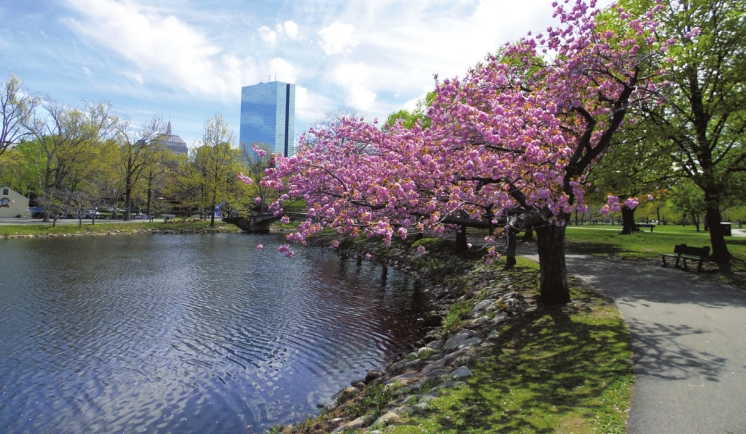
The Esplanade Association, the nonprofit that stewards the Esplanade along the Charles River, is celebrating its 25th anniversary this month.
“We are proud of our first 25 years of care for this historic urban greenspace,” the association wrote in its anniversary newsletter. “We were founded to make life better on the Esplanade for all, and that mission still rings true today.”
The
idea for an association first blossomed in the 1970s with a group of
Back Bay and Beacon Hill residents. During this time, a number of
advocacy groups had formed for city owned parks like the Public Garden.
But because the Esplanade is state owned land, none of those groups
could care for it. After many years of informal organizing, the
association formally began in 2001.
“You
could think of our work as amplifying the care of the park beyond what
our friends in the state can do,” Jen Mergel, the association’s
executive director, said.
Nicole
LaChapelle, the commissioner of the state’s Department of Conservation
and Recreation, said that the association had been a “tireless partner”
in shaping the park to be “vibrant, welcome, and accessible.”
The
state is responsible for basic logistical care, like taking out the
trash or turning on the water in the springtime. The association handles
the details like planting trees, repairing benches, hosting free
fitness classes. In 2017, for example, it ran irrigation through the
Oval Lawn in front of the Hatch Shell, so that “when people are sitting
for concerts, they’re sitting on a beautiful green space and not a mud
pit,” Mergel said.
The
association’s biggest project yet, and the one Mergel is most excited
for, is currently underway. This fall the association will open its new
Charlesbank campus and Smith Family Pavilion across from Mass General.
According to the Esplanade Association website, the $20-million-value
two-acre site will be a “universally accessible space designed for
recreational, civic, artistic, educational, and cultural activities.”
“That
will really transform people’s access to the park,” Mergel said. “We’ll
have year round restrooms, year round water, year round shelter across
temperatures and weather conditions. If there’s lightning and the kids
in the Teddy Ebersol [baseball] fields nearby need some shelter, we can
be there. It’s going to be a game changer.”
Improving
access to the park is also what the association plans to focus on in
the future. One example Mergel gave was to provide school bus transit
grants, so that visitors could bring a school bus of kids and have the
funds to park that bus at a nearby lot. But there are also concrete
projects the association wants to take on that are driven by community
input.
“There is a
space behind the Arthur Fiedler Memorial that we call Fiedler Field,”
Mergel said. “That space still has bits of asphalt and debris and
compacted crab grass, and it’s not a proper field. We would love to make
that a beautiful field with irrigation. There are just parts of the
park that we know are beloved, and people would really love for them to
be a little bit more inviting.”