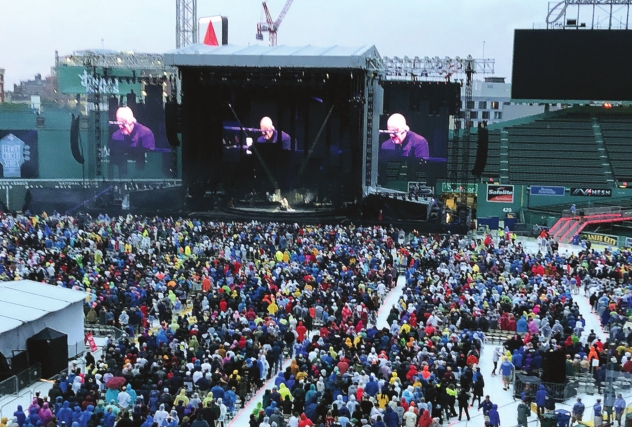
The Boston Red Sox have been providing free tickets to Fenway Park concerts to neighborhood organizations since early in the modern concert series’ 2003 onset.
The team describes the practice as an effort to give residents access to shows staged in their own community.
“For at least the last couple of decades, we have made available several hundred complimentary tickets each year to neighborhood nonprofits and organizations," said David Friedman, the Red Sox’s executive vice president of legal and government affairs.
The initiative dates back to the early years of Fenway Park’s modern concert series, which began in 2003 with Bruce Springsteen and The E Street Band.
“It’s
not formal, in this sense that we don’t have a formal policy document.
It’s just a way to give back to the community and to reinforce our
relationship with the neighborhood,” Friedman said. “If you live in the
neighborhood, we want there to be some degree of ability to come to our
shows.”
Local groups receive a combined total of a few dozen tickets per show, with availability varying from one show to the next.
Friedman
said that regular recipients included nonprofits such as the Fenway
Civic Association (FCA), the Fenway Community Center and the Art
Resource Collaborative for Kids, but that many other organizations were
recipients as well.
A
spokesperson for the FCA said that they use the tickets as a prize for
community-centric trivia contests to “enhance civic engagement by giving
people questions that get them to think about their community.”
The
organizations that receive the tickets can use them in a variety of
ways. Unlike the free tickets to Red Sox home games that are regularly
distributed through the Red Sox community ticket request application,
the team permits the use of the gifted concert tickets for the receiving
organizations’ fundraising efforts, such as raffles or auctions.
“By
and large, it’s going to be groups or entities that are in the Fenway
area. I wouldn’t say 100% exclusively, but pretty much organizations
where their membership or their services are focused in the Fenway
area,” Friedman said.
Friedman
said the Red Sox have also been able to provide community members with
pre-sale access to purchase tickets through an email mailing list. While
pre-sale is different from the gifted tickets, in that they must be
bought, it is significantly cheaper to buy concert tickets at the
pre-sale price than it is to buy them on the secondhand market after
popular shows sell out.
Residents can receive those opportunities by joining the team’s neighborhood email list.
“We
have our own list of neighbors who receive a weekly update email from
us on Fenway Park activity,” he said. People interested in being added
can contact the Red Sox directly. “Within one or two emails or phone
calls, they’d be sent to the right person,” Friedman said. “We’re not
that big of a bureaucracy.”
For
organizations not already connected to the Red Sox, Friedman encouraged
outreach. “If they reached out, we would have a conversation and figure
out how they fit into our overall plans, and try to make some efforts
to include them,” Friedman said. “We’re grateful to support these local
organizations and provide some degree of support and access.”