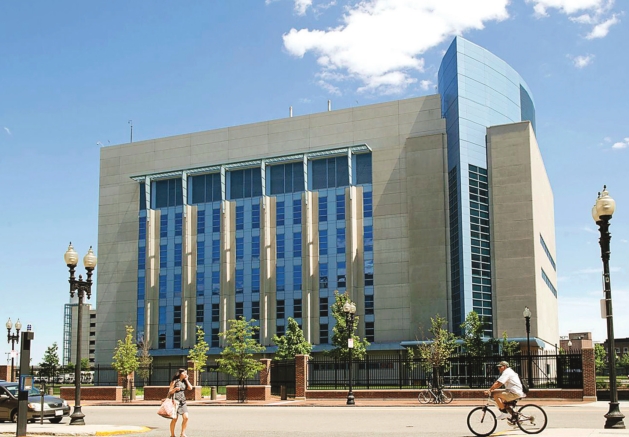
Officials for Boston University’s National Emerging Infectious Diseases Laboratories (NEIDL) revealed during its annual meeting that it would be getting some system upgrades thanks to new grant funding.
Nicholas Murphy, NEIDL’s associate director of facilities and engineering, said during the meeting that thanks to the CO6 grant, a funding opportunity from the NIH to improve existing laboratory spaces, animal facilities, or construct new biomedical research facilities, they had begun the process of engaging construction management firms.
They were awarded $7.5 million in September, 2024 from the grant
The
first goal is to modernize the BLS3/ABSL-3 laboratory spaces by
installing bubble tight dampers on supply ducts to enable isolation
during fumigation and update room pressure controllers for precision
HVAC controls. The second is to configure an Arthropod Containment
Level-3 to optimize for vector transmission studies in adjacent vivarium
space. The third is to modernize BLS-4 airlocks to chemical shower
decontamination capability.
As
the projects are in their earliest phases of actualization, Murphy did
not provide a timeline on when these projects are expected to be
complete. Actual construction would begin after they receive approvals
from the NIH.
Murphy
went over several other capital projects and operational improvements
that NEIDL is undergoing. Those include the migration to the latest BAS
operating platform, recoating of epoxy floors, automatic transfer switch
modernization along with yearly recertifications and equipment
rebuilds.
Director
Robert Davey mentioned during the meeting that the NIEDL has been
increasingly making efforts to move away from animal testing to pursue
biophysiological systems, which act as a sort of miniature version of an
organ, as modules to perform therapy testing and development.
“We’ve
always been interested in this, but the NIH is now pushing this hard,
and we’re excited to be a part of this initative,” he said.
How
it’s done, he explained, is by taking cells from people through
biopsies or blood samples and creating miniature organs out of them that
can be used for testing in a dish.
Officials
stressed the focus on safety as a top priority at NEIDL, which conducts
research on potentially dangerous emerging infectious diseases, honing
in on the extensive training lab and the continual oversight of its
practices and protocols at the site.
“There’s
a feedback process of learning from how we do things from all these
people, and making our systems and processes better and better,” Davey
said of NEIDL’s rigorous training program conducted at its purpose-built
training lab. “So, this is an exciting this to grow.”
Kevin
Tuohey, chief safety officer for NEIDL said that much of the safety
measures of the facility were largely designed and implemented during
its construction and thought about as it relates to the operational
planning of the building, and they have so far been successful.
New
safety protocols for the facility are first looked at and approved by
the Institutional Biosafety Committee, which includes members of the
public, before it is submitted to the Boston Public Health Commission
(BPHC). Once approved by the BPHC, 30-day notice is provided to the BPHC
executive director and the Boston City Council.
“It’s
a very thorough, very long multiple review type of process before we
even start initiating things like how you bring the agent into town,”
said Tuohey.
Paired
with that rigorous protocol oversight, the facility undergoes several
assessments and inspections over the course of the year. The CDC and the
BPHC conduct both announced and unannounced inspections of the facility
in addition to routine Boston Fire
Department inspections and output monitoring from the Water & Sewer
Commission and Massachusetts Water Resource Authority.
On
the side of community safety, the facilities comprehensive emergency
management plan includes commitment to perform three exercises a year
and provide training to all internal and external responders. Those
exercises require that security, building and biosafety events be
tested.


