Residents near Charlesgate Park were granted some temporary relief last week, after the state finally addressed weeks of escalating concern with a growing encampment of unhoused people.
The Massachusetts Department of Conservation and Recreation (DCR) issued an eviction notice last week to an encampment that has spread out along Charlesgate Park and the banks of the Muddy River. The notice states that they are to “vacate the Charles River Reservation property” and remove all personal belongings no later than 8am the week of October 20 to October 24.
The DCR declined an interview request but said in a statement, “We are seeing a rise in unauthorized camping sites and encampments on DCR owned property, which has created public health, safety, and environmental risks, including fires and erosion.”
Residents
said that there had been a sudden, frightening shift in the demeanor of
the persons using the encampment into a more menacing crowd.
Local
community organizer Caroline Reeves, a leader at the Charlesgate
Farmers Market and the Muddy Water Initiative, said that the farmers
market has been broken into twice in recent weeks and that she fears for
the safety of volunteers doing their regular river cleanups.
“I
rent a porta potty from June to October, and I leave it open for the
unhoused, because I feel that's dignity. But usually, these people are
good neighbors to us and this new crowd, it's scary,” Reeves said in an
interview.
When she
recently came across someone going through her storage bin, where she
once would have approached them, she now waits for a police response.
“The
homeless are victims as well. This lovely guy, clearly in a bad place,
said, ‘Oh, they're stealing from me too.’ We can go into our houses and
shut the door and lock them, but these gentle people who were using the
park are now also victimized by this new threatening element,” she said.
On
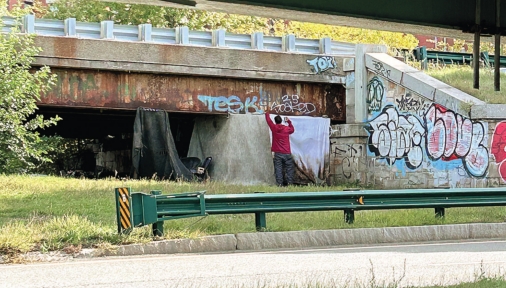
October 9, the eviction notice, dated October 6, could be seen posted
beneath the Bowker Overpass offramp leading to Charlesgate East. Beneath
the notice were signs of a well-established encampment.
Wooden
slats had been pulled down from the overpass and replaced with plywood
flooring, creating a crawl space into the overpass that could be entered
from below. Just last year, this location was the cause of a fire that
shut down the offramp.
A
nearby park space locals refer to as “the circles” was littered with
bright orange hypodermic needle safety caps and broken syringe pumps.
The mobile sharps team had made a pass at the area a day before, at the
request of residents.
The encampment spreads north from the circles and includes at least two locations with similarly dug-in shanty structures.
George Lewis, a local resident, has been pressing the city and state for a more permanent solution for some time now.
“They
move the people out of Melnea Cass, they go somewhere. They move the
people off the BU Bridge, they go somewhere,” Lewis said. “Something
needs to get done to help these people. Moving them from one
neighborhood to the other doesn't solve anything.”
If
the encampment were on city property, the Unlawful Camping Ordinance
would require that the city offer shelter and temporary storage of
property before removal of the encampment. Since Charlesgate Park is
managed by the state DCR, the ordinance doesn’t apply.
In
its statement, the DCR said that the policy they are developing in
response to the rise in unlawful encampments is to evaluate the site
with the help of a public health advisor in collaboration with the
Department of Public Health. In this case, the public health risk was
deemed high due to the presence of hazardous materials.
In
the intervening period before the eviction takes effect, the DCR has
partnered with state agencies and local social service organizations,
who will be onsite to offer the unhoused people access to social
services.
The DCR
could not answer what would happen if the people had still not vacated
the area by the time of the eviction notice’s deadline.