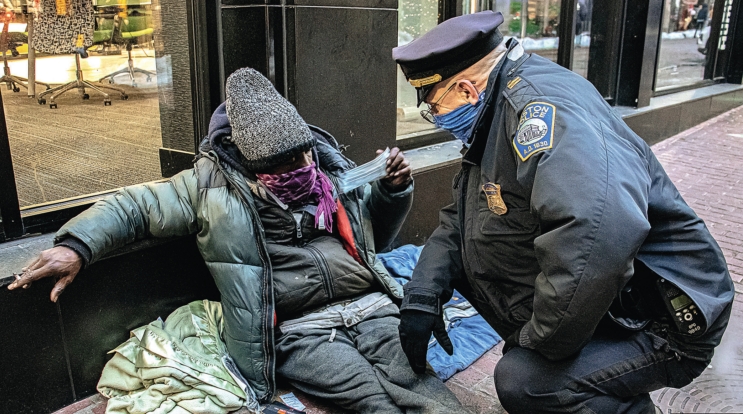
Downtown’s public safety efforts were a hit over the summer, but successes have started to stagnate as the weather begins to cool.
In February, a group of Downtown community stakeholders convened a public safety summit with over 100 government and civic leaders at both city and state levels to try to figure out how to address the growing open-air drug use problem in the neighborhood.
As
a result of that meeting, attendees formed task forces and outlined 56
projects ranging from state level policy to public realm activation, to
increased police presence, to basic infrastructure improvements. Thanks
to that, the neighborhood had a blossoming summer.
“We
had a pretty solid late spring, and I would say the summer was probably
the best we’ve had on the Boston Common in four or five years,” said
Rishi Shukla, head of the Downtown Boston Neighborhood Association, who
is heavily involved with public safety efforts Downtown. “There was a
surge in resources to address the issues that came out of the February
meeting. That made a significant difference in terms of decrease in
needles, decrease in human waste, decrease in quality-of-life issues.”
That
feeling of safety is in part reflected by Boston Police Department
crime statistics for District A-1 that are published weekly. In 2025,
for example, there were 153 cases of non-domestic aggravated assault as
of October 5. In the same period of time in 2024, there were 193 cases,
meaning this year’s decrease was about 21 percent.
But
it wasn’t unilateral. Public crime incident report records show that
A-1 has 458 total reports for drug possession or use so far this year.
Most of those reports occurred in the spring and summer months.
Commercial burglaries have also gone up by 74 percent compared to the
same period of time last year, from 66 cases in 2024 to 106 cases in
2025.
And as fall sets in, Shukla said, the successes the neighborhood has enjoyed have plateaued.
“I
would say the last three to four weeks have been more challenging,”
Shukla said. “We always knew that this surge in effort and resourcing
across the board was effectively a giant bandage. The reality is, we’re
starting to see the influx of Mass and Cass populations coming back into
Downtown and into the parks. It’s not as strong of a surge as it was a
year ago, but it’s definitely happening.”
Residents
have begun avoiding some historic drug use hotspots as drug use there
begins to pick up. “Park Street and Tremont Street, which is
affectionately known as K2 Alley, is now a hotspot again,” Shukla said.
“If you go there between 7 and 11pm, you’ll probably see a police
cruiser parked there on a semi-permanent basis because it has gotten bad
again. You see a lot of dealing out there. Eventually, there’s going to
have to be a more permanent set of solutions to get to the root cause
of this.”
To review
their successes since the February meeting, the groups and leaders
involved in the first summit will be hosting a second summit on
Thursday, October 30. That meeting will be open to the public as a way
to fully reflect on what has worked and what hasn’t.
“As
of now, the plan is for all of us who are serving as task force
co-chairs to facilitate this conversation,” Shukla said. “We want the
general public to be able to watch the discussion, the debate. We’ve got
everyone in the room again.”