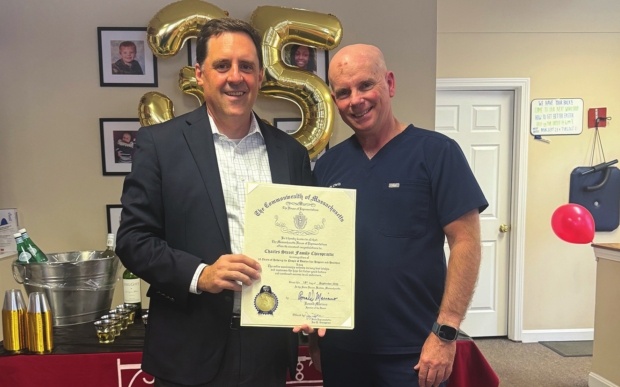
State Representative Jay Livingstone presents Chris Quigley with a proclamation commemorating his 35th anniversary When Dr. Chris Quigley founded Charles Street Family Chiropractic at 102 Charles St. in 1990, the central artery of Beacon Hill was a very different place commercially and residentially. From Charles Circle to Beacon Street, Charles Street has long been a point of influence for the heartbeat of Downtown.
In 1982, Beacon Hill resident and Boston Mayor Kevin White had changed the direction of Charles Street's future by changing the direction literally, switching the flow of traffic from northbound to southbound and turning a logjam of suburban motorists rushing past adult bookstores into the hub of local boutiques and eateries you know today.
On
Wednesday, September 18, Quigley celebrated 35 years of business, and
he reminisces in an interview about how far his business and those city
blocks have come.
“I
didn’t have a clue about neighborhoods in Boston,” Quigley said. “The
reason we moved up here is because my wife had to do an internship, so
we stayed at her friend’s place on Pinckney Street.”
By
the time his business moved in, the adult bookstores and neglected
local shops of Charles Street had given way to a dozen antique shops and
numerous real estate agencies.
“The
makeup of the neighborhood’s changed dramatically. When I was first
here, there was a huge percentage of renters in Beacon Hill and every
September 1, I would lose about 20% of my practice,” Quigley said.
“Especially the last 10 years, a lot of the apartments have been [made
into condos].”
He also
pointed out how the demographic of visitors and residents has
diversified, saying on any given day one can now hear several different
languages on a Charles Street stroll.
The
commercial aspects of Charles Street have been through another shift as
well. Antique shops and real estate offices have moved online, replaced
with restaurants and local fashion boutiques.
But significant reduction in crime has been the biggest local relief for Quigley.
“On
the day of my grand opening party back in late 1990, a homeless guy
stabbed another homeless guy in the eye and killed him right on Charles
Street, and my dad was like, ‘Where are you living here?’” Quigley said.
“I had several patients get mugged over the years. So decreasing crime,
I think that's been the number one thing that I've personally seen.”
While
many businesses did shutter during early lockdowns, compared to other
neighborhoods, Quigley said Charles Street has even had a better bounce
back from the COVID-19 pandemic. In neighborhoods like Fenway, the
closure of many small, locally owned business was a primer for
opportunistic national corporations to buy up properties and set up
shop.
“Charles
Street's been very resistant to that,” Quigley said. “You look at some
of the office spaces here, they’re tiny. I don't think a chain would be
interested.”
Today,
plans exist as part of the City’s Connect Downtown project that are
attempting to balance the diverse needs of Beacon Hill’s central artery.
It plans to explore replacing the brick on existing sidewalks, which
Quigley says has seen significantly less maintenance in recent years,
and create a link in Boston’s bike network while still serving the needs
of small business.
There is currently not even a one-way bike lane on Charles Street, but Quigley says its complicated.
“Charles
Street is five lanes across. Two lanes of parking, three lanes of
travel, but most of the day, Charles Street is only a one lane street,”
Quigley said. “People need double parking to unload stuff, and now we're
[in] gridlock.”


