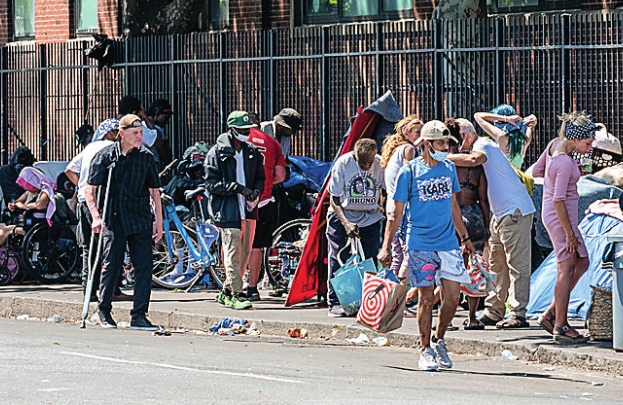
New strategies promised by the Wu administration to address homelessness and drug trafficking around Mass and Cass are yet to materialize, with conditions steadily worsening for residents and businesses.
While last November’s tent crackdown succeeded at banishing the encampment formerly at the intersection of Massachusetts Avenue and Melnea Cass Boulevard or Atkinson Street, strict enforcement within those bounds seems to have only displaced that activity slightly further afield.
Sue Sullivan, executive director of the Newmarket Business Improvement District (BID), says local businesses have once again seen a rise in disruptions from addicts coming to the area for its drug trade.
“The businesses in that immediate area are having a really hard time. We’re back to 100, 125 people out there on a regular basis. The Sonoco, DiPierro Construction, Dun and Bradstreet Lumber, the Hampton Inn. You’re trying to do business, and you’ve got people doing drugs in your doorway.”
The BID maintains a private security force that clears streets and roadways when they’re obstructed by gatherings, but they’re responding to more than 35 calls each day. In May their daily count sat around 20.
City officials acknowledged months ago that new strategies were needed to address a population now composed mostly of people that do have shelter options but come for the drug trade and social fabric, with Boston Public Health Commission head Dr. Bisola Ojikutu telling civic groups in June the city needs “new solutions.”
In the time since, however, no comprehensive plan has emerged. Sullivan says police surged enforcement against open air drug use in June, but out of roughly 150 arrests only 4 people were detained, and enforcement soon tapered off.
“They did it very heavily in the month of June. But how that turned out isn’t the fault of the police, that’s the fault of the courts. They have continued to make drug arrests, but at the level of that really strong offensive push. Police are understaffed too, especially in the summer,” said Sullivan. “They have enough trouble staffing regular patrols, let alone increasing them.”
In the long term, city government seems to be banking on reopening the large-scale drug treatment facilities on Long Island. Even optimistic timelines have those years away from being operational.
In the meantime, civic groups have proposed Recover Boston, a similar recovery campus on a smaller scale. The original proposal for Widett Circle was immediately shot down by the Wu administration, but the mayor’s office has since cautiously hinted they might be open to supporting the same plan in a different spot.
Sullivan says they’re vetting alternate locations and could be ready to move forward “in the next few weeks.” Whether the mayor’s office actually approves of them, and whether civic groups can get past funding and organizational hurdles, remains to be seen.