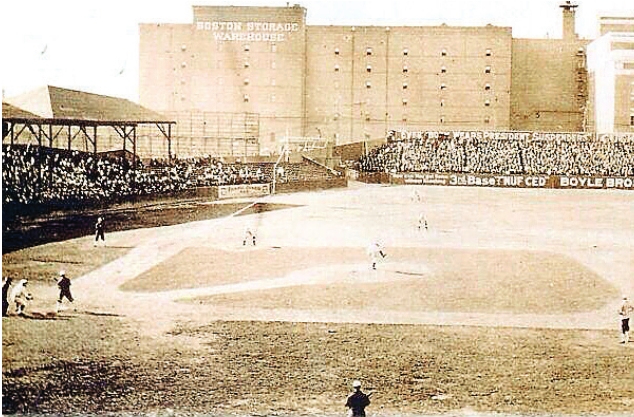
The Huntington Avenue American League Baseball Grounds was one of the most popular and well-attended baseball fields in Boston in the early twentieth century. The large open-air field was on Huntington Avenue, just west of Massachusetts Avenue and opposite the Boston Opera House. It was the first home of the Boston Red Sox.
In 1901, ground was officially broken in the Fenway area of the city for the new baseball field, with a covered grandstand and high wood fences, that was to have a capacity of 11,500 spectators.
The open land chosen had often been used for traveling circuses, and was extensive by present standards.
It measured 530 feet to center field, and was later expanded to 635 feet in 1908. It was not considered a perfect baseball field, as there were scattered sand patches where grass refused to grow, and a tool shed inconveniently placed in deep center field that was incongruous to the game.
However, the grounds were the first home of the American League Boston Red Sox, also known locally as the Boston Americans until 1908. It was separated from the baseball park of the South End Grounds, home of the Boston Braves, by the railroad yards of the New York, New Haven and Hartford Railroad.
The baseball field was the site of the World Series game between the current American and National Leagues in 1903, the first perfect game in the modern era, thrown by Cy Young in 1904.
The Huntington Avenue Grounds was a popular sporting venue, and in 1908 it was expanded, with center field and right field enlarged. However, it was still an open-air sporting ground and not a true stadium, and it became less desirable as a place for Major League Baseball games.
Former owner of the Red Sox, John Taylor, son of The Boston Globe publisher, later decided that the grandstand was not adequate for the large numbers of baseball fans and that his team deserved an appropriate and modern stadium. Taylor had Fenway Park built not far from the old Huntington Avenue Grounds, and after the 1911 season ended they moved to their new stadium on Jersey Street. The Huntington Avenue Grounds was demolished in 1912 after a decade of use.
Anthony Sammarco is a noted historian and author of over sixty books on the history and development of Boston.