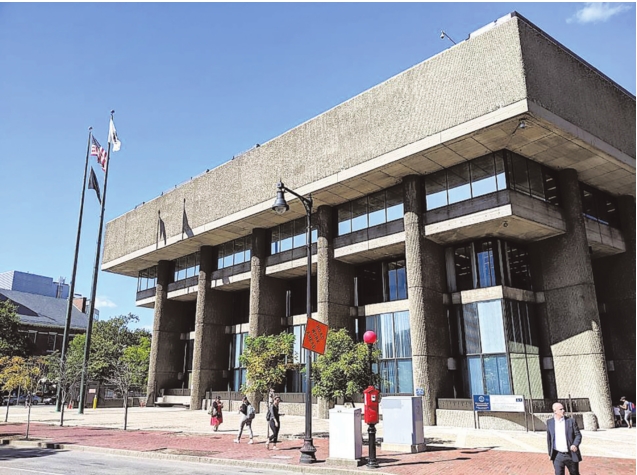
The redevelopment of the Hurley state office building, a massive icon of Brutalist architecture on Cambridge Street, looks to be going nowhere fast.
Nearly two years after splashy rollout, Leggat McCall has yet to submit its $1 billion proposal to transform the Hurley to Boston City Hall for review, the first step for any major project.
And a key element of the development firm’s plan, which calls for renovating the early 1970s concrete monolith and placing two towers atop it, is “no longer viable,” one veteran Boston area developer, not connected with the plan.
In particular, one of the two towers was to be expensive lab space. But that market, red hot two years ago, has since imploded, with empty research complexes having opened up across Greater Boston amid a surge of speculative development.
A top Leggat McCall executive declined comment when contacted by Contrarian Boston, citing a confidentiality agreement with the state authority overseeing the Hurley building redevelopment plans.
A spokesperson for Division of Capital Asset Management & Maintenance said the agency could not provide an update on the project’s status at this time.
Overall, Leggat McCall’s plans envisioned a one million square foot complex that included a renovated Hurley at the base topped by two towers, one full of labs, the other packed with hundreds of apartments.
However, if nothing else, the 2025 target date the developer gave for breaking ground on the project may no longer be feasible.
Even if Leggat McCall were to file a proposal tomorrow with the Boston Planning & Development Agency, it would take at least 18-24 months to review, noted one long-time local real estate executive.
That would push the start of the project into 2026. If the developer and state officials are forced to go back to the drawing board, they will likely face pressure from neighborhood groups to reexamine the proposal.
Some in the architectural field have been vocal about preserving the Paul Rudolph designed Hurley building as a monument to the Brutalist style of architecture, which was popular in the mid-20th century. Others were far less enthusiastic about saving these giant concrete monstrosities.
Scott van Voorhis is the author of the blog Contrarian Boston.


