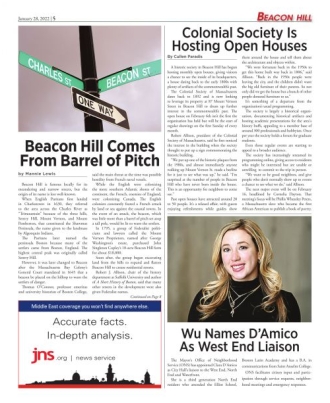
Beacon Hill is famous locally for its meandering and narrow streets, but the origin of its name is less well-known.
When English Puritans first landed in Charlestown in 1630, they referred to the area across the Charles River as “Trimountain” because of the three hills, Sentry Hill, Mount Vernon, and Mount Pemberton, that constituted the Shawmut Peninsula, the name given to the landmass by Algonquin Indians.
The Puritans later named the peninsula Boston because many of the settlers came from Boston, England. The highest central peak was originally called Sentry Hill.
However, it was later changed to Beacon after the Massachusetts Bay Colony’s General Court mandated in 1645 that a beacon be placed on the hilltop to warn the settlers of danger.
Thomas O’Connor, professor emeritus and university historian of Boston College, said the main threat at the time was possible hostility from French naval vessels.
While the English were colonizing the more southern Atlantic shores of the continent, the French, enemies of England, were colonizing Canada. The English colonists constantly feared a French attack by land or sea against the coastal towns. In the event of an attack, the beacon, which was little more than a barrel of pitch set atop a tall pole, would be lit to warn the settlers.
In 1795, a group of Federalist politicians and lawyers called the Mount Vernon Proprietors, named after George Washington’s estate, purchased John Singleton Copley’s 18-acre Beacon Hill farm for about $18,000.
Soon after, the group began excavating land from the hills to expand and flatten Beacon Hill to create residential streets.
Robert J. Allison, chair of the history department at Suffolk University and author of A Short History of Boston, said that many other streets in the development were also given Federalist names.
Pinckney
Street was named after Charles Cotesworth Pinckney, a Federalist
politician from South Carolina who lost presidential races to Thomas
Jefferson and James Madison. Derne Street was named to commemorate the
efforts of William Eaton, a Federalist who fought in the Battle of Derne
in Tripoli, Libya, during the First Barbary War.
Main thoroughfares got their names from their destinations, like Cambridge Street.
Beacon
Street got its name because it was the most direct route to the beacon
on top of the hill. Charles Street was named after the river that
separates Boston and Cambridge.
The
story of how the river got its name is more unique. When John Smith,
the English explorer who charted the North American coast, displayed his
maps before the royal court, he told King Charles I that he thought
Boston’s main waterway was the largest on the continent. When Prince
Charles heard this, he asked that the river bear his name.