
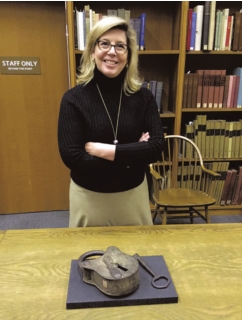
Beth Prindle displays the lock used to imprison William Lloyd Garrison.
Where in Boston could you find in one room a 4,367-year-old receipt scratched in clay from ancient Mesopotamia, Paul Revere’s original sketch of the Boston Massacre and the double-edged pike that abolitionist John Brown carried during his attack on Harper’s Ferry?
Try the Rare Books and Manuscripts Department of the Boston Public Library (BPL), where Beth Prindle, head of special collections, presides over 250,000 books and an estimated 1 million manuscripts, fine art, photos and more representing the “priceless intellectual heritage” of living and vanished cultures that shape our world.
“Our mission is to provide access to everyone,” she said.
To enter the “secure room” in the third floor of the McKim Building, visitors must register with a photo ID and remove their coats, hats and bags.
With a few exceptions, they are not required to don white gloves for handling documents or most objects, said Prindle.
“It’s important visitors retain a sense of tactility that lets them handle rare objects with the care they require,” she said. “The major exception would be photographic negatives, which must be kept free from human touch.”
Prindle showed several objects so esoteric they make one want to spend days exploring the collection. “They’re not just objects and paper,” she said. “Everything has a story.”
Taking out a large padlock that looked like it belonged on a medieval dungeon, she said it had been used to jail William Lloyd Garrison in 1835 from a pro-slavery mob that stormed his abolitionist lecture.
Prindle compared Revere’s 1770 bird’seye sketch of the Boston Massacre that showed the bodies of Crispus Attucks and three other dead colonists as one of the “first pieces of forensic evidence” used in an American court by future president John Adams to successfully defend a British officer charged with giving the order to fire.
While many visitors have seen John Singer Sargent’s famous murals on the third floor of the McKim Building, few know about one of the BPL’s strangest artifacts such as the death masks and commingled ashes of anarchists Nicola Sacco and Bartolomeo Vanzetti, who were executed amid great controversy for murder in 1927.
Prindle said the digitalization of rare books and artifacts found on the BPL’s section of archive.org and digitalcommonwealth.org let viewers enjoy the library’s rich collection during the inventory. “We hold these things in the public trust, and I believe the public should have access to them,” she said. “Digitalization gives them new life.”