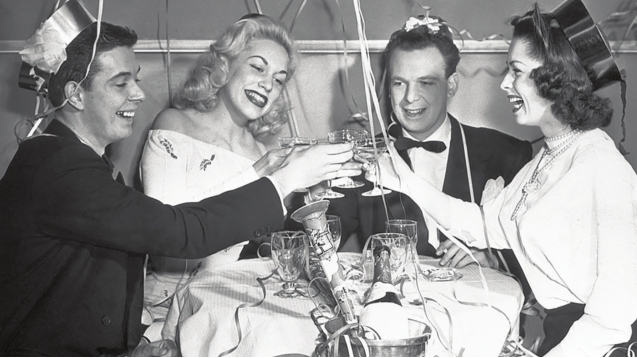
Photo credit: Courtesy of Anthony Sammarco
On January 1, 1701, Samuel Sewall, a prominent Boston jurist and Beacon Hill resident, distributed an ode to the new year and sent trumpeters to the Boston Common to herald the arrival of the hours-old 18 th Century.
Though festivities were often muted in colonial times, New Year’s 2021 will continue the celebration of a holiday that has been commemorated in Boston for hundreds of years.
In 17 th Century New England, Christmas traditions were frowned upon, which caused some Bostonians to restrain their celebration until the new year.
Although Massachusetts operated on the Julian calendar, which put New Year’s on March 25th, many residents still commemorated the holiday on January 1.
“It
was illegal to celebrate Christmas during the Puritan ascendancy,”
Peter Drummey, the Massachusetts Historical Society’s librarian, told The Boston Guardian. “In some respects, they had New Year’s in lieu of the Christmas holidays.”
Still,
New Year’s celebrations were minor in the colonies until the 19 th
Century, when droves of new immigrants arrived on American shores.
Scots-Irish newcomers brought with them a poem by Robert Burns called Auld Lang Syne, which they sang as the clock struck midnight on December 31.
In
1863, amidst the devastation of the Civil War, thousands filled the
Boston Music Hall and Tremont Temple to await the news from Washington,
where President Lincoln’s Emancipation Proclamation, which would free
enslaved people living in Confederate states, was scheduled to go into
effect.
Abolitionists
like Frederick Douglas and William Lloyd Garrison attended musical
performances while a string of citizens stood between the concert halls
and the telegraph office, ready to conduct the announcement to the
anxious crowds.
“People
who were ardent in the abolitionist cause had to see the news to really
believe that it had happened; they had to have the proof,” Drummey
said. “This was the only time that Boston had historically celebrated on
a scale that we associate with New Year’s [today], but for reasons
completely apart from the holiday.”
In
the following decades, immigrants continued to arrive and change the
annual traditions. Many were fleeing famine, revolution, or persecution.
“These people were bringing new traditions, new thoughts, and new beliefs,” Anthony Sammarco, a Boston historian, told The Guardian. “[Many] were looking to the new year to be better than the old one.”
In
the 20 th Century, other traditions developed, like the annual polar
plunge in Dorchester and ice skating at the Frog Pond. Immigrants from
Latin American countries brought the practice of eating a dozen grapes
at midnight. In 1976, artist Clara Mack Wainwright reinvigorated the
city’s holiday by establishing First Night, a celebration that gathered
musicians, artists, and revelers.
“Parkas
and hiking boots on the Common…rocking saxophones in the frigid night
air, thrumming guitars in the warmth of a Catholic church, champagne on
Beacon Street, beer at Park Street Station, and vice versa,” reported The Boston Globe the following day.
First Night grew each year, and by 1990 over a million people were attending the celebration, according to the Globe.
In
2013, the First Night organization closed for financial reasons. Since
then, the city-run event has attracted fewer attendees. Last year, the
First Night bash was entirely virtual, with musical performances
broadcast on television and online.